Executive Summary

Talent and Workforce

Yes, Colorado's population growth has slowed in recent years.

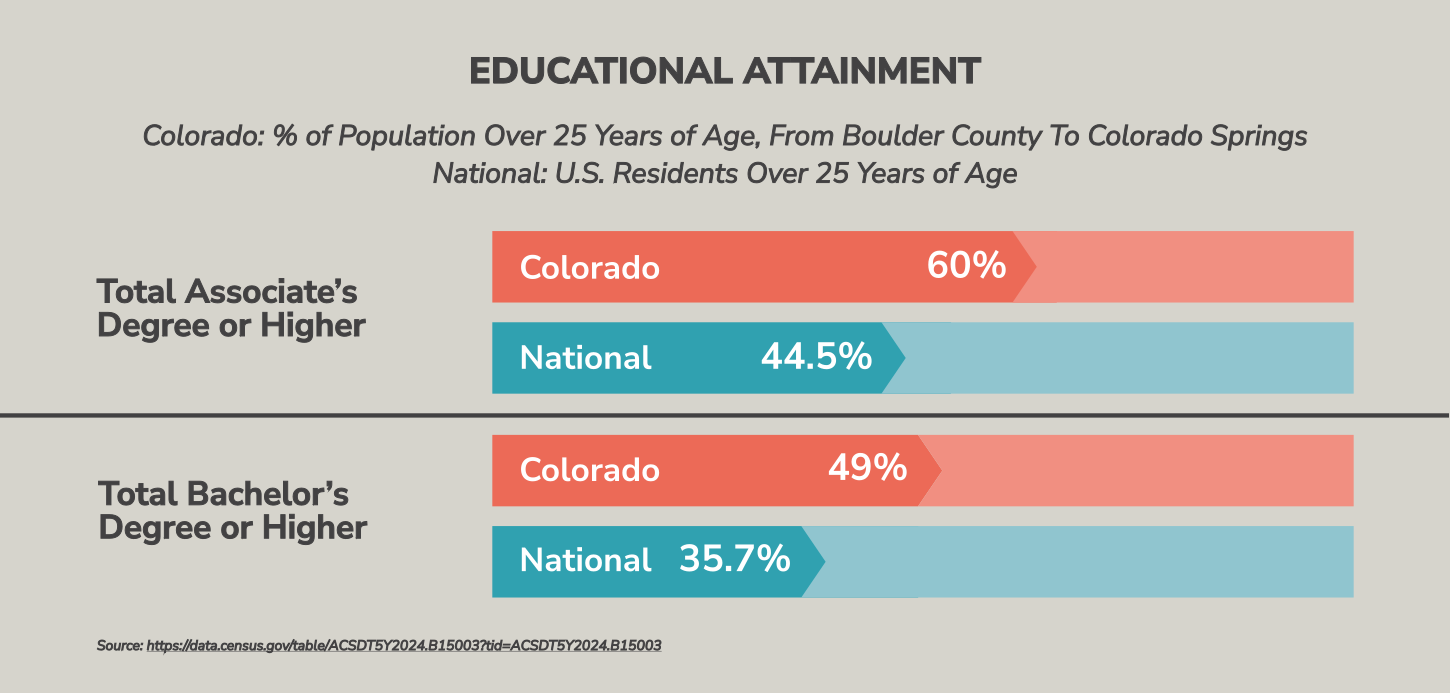
And the Front Range's talent pool remains one of the most educated, most engaged, and most in-demand in the country.

The market is evolving. The post-pandemic population boom has cooled off, and job growth has settled into a more sustainable rhythm. Job growth isn't what it was five years ago. Competition for top-tier talent is real. These are real shifts worth paying attention to.

But the professionals in the Front Range are exceptionally qualified. The institutions training the next generation are producing more talent than ever. And companies, from global headquarters to small startups, are still choosing the Front Range specifically because of the businesses that make the market.

This chapter looks beyond the population narrative and digs into what matters to business leaders: the quality, depth, and trajectory of the Front Range talent pool.

What's Inside?

Companies Choose the Front Range for Talent

CEO of Intellistack Aled Miles points to an "untapped tech talent pool" in Denver, after he moved the company headquarters to the region in 2025. That's why he committed to growing the business by 10% year over year.

A number of corporations have moved their global headquarters to Denver to tap into the state's talent and outdoor culture.

In this chapter, we feature the companies making talent-driven decisions to build on the Front Range and why out-of-state recruits say yes to Colorado.

“We got a new CEO a year and a half ago, Aled Miles, and he started finding more of the people he wanted to hire here Denver, and the more he looked into the market — because he's actually from California — he realized there was a basically an untapped tech talent pool here."”

Chris Benham, CMO at Intellistack

The Talent Is Growing…Faster Than the National Average

Colorado's talent pool keeps growing, and businesses continue to experience job growth and business expansion.

We unpack the CU Boulder 2026 economic forecast, the sectors leading job growth, and what the data says about the Front Range's labor trajectory over the next several years.

Read the Chapter: The Talent Is Growing…Faster Than the National Average

Talent pool growth, 2017–2025

Colorado12%
United States7%
CO businesses expanding or holding headcount74%
Major industries adding jobs in 20268 of 11
Source: Kansas City Fed, Colorado Business Roundtable, CU Boulder 2026 forecast

Building the Pipeline Through Education

A Small Sampling of the Pipeline. The Front Range's talent advantage is built on a robust network of institutions producing job-ready graduates.

Universities: CU, CSU, Colorado School of Mines, University of Denver, MSU Denver, Regis University

Community Colleges: Red Rocks, Arapahoe, Front Range Community College, and more

Trade & Technical Schools: Emily Griffith Technical College, Lincoln College of Technology, Spartan College of Aeronautics

K–12 Career Pathways: Douglas County's Legacy Campus expansion, GALS Denver's surgical robot program, the HOPE Institute healthcare camp

Inside, we explore the education-to-employment pipeline and show how schools at every level are preparing the next generation of the Front Range workforce.

Read more: Building the Pipeline Through Education
  1. Universities
  2. Community Colleges
  3. Trade & Technical Schools
  4. K–12 Career Pathways

The Talent Blastoff in the Aerospace Sector

The Front Range has become a gravitational center for talent in space, defense, and advanced manufacturing, and for good reason: Colorado ranks No. 1 in the nation per capita for aerospace and defense industry concentration. The sector has grown by 88% across the state, more than any other emerging industry in the Denver and Boulder metros.

Inside, we explore how the aerospace cluster strengthens the broader talent ecosystem and why companies in adjacent industries are benefiting from the opportunities.

Read now: The Talent Blastoff in the Aerospace Sector

Colorado Aerospace

2,000+ businesses
55,000 direct employees
184,000 indirect employees
$22.8B in federal aerospace funding

Making hiring decisions, building a team, or deciding where to grow your next office requires the right talent pool that's poised for growth. This chapter gives you data insights on the Front Range talent population so you can build your business with confidence.

Yes, the talent wars are real.

And on the Front Range, you already have the home-field advantage.